
Driving Towards a Net Positive Cosmetics Industry
Sustainability is a key focus for us all. As the public voice of the UK cosmetics and personal care industry, CTPA is in a unique position to effect change at a pre-competitive level.
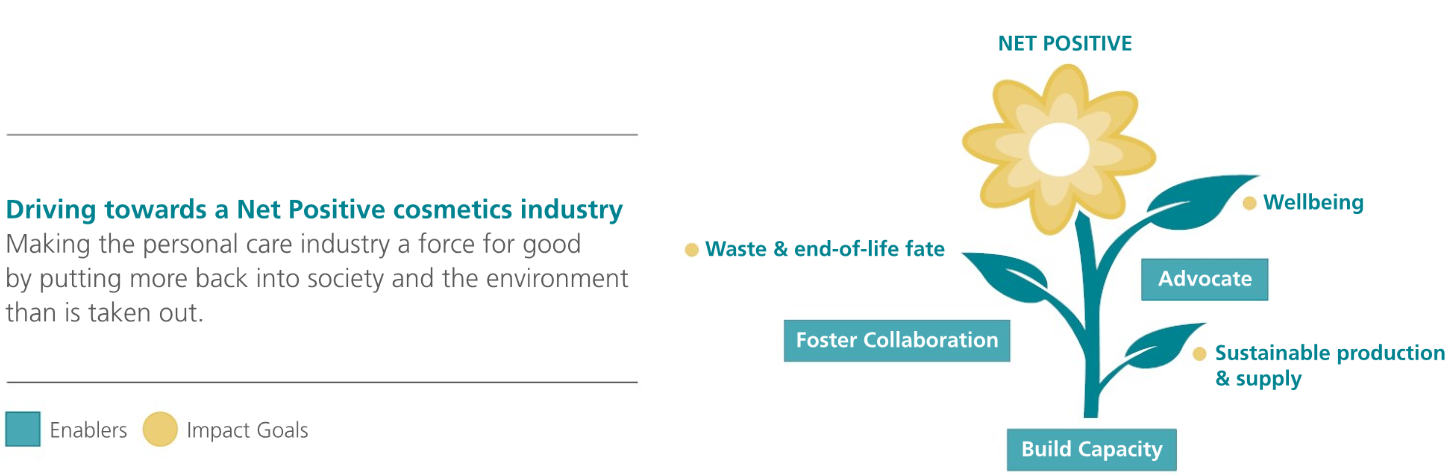
CTPA worked with leading International sustainability non-profit organisation, Forum for the Future, to develop an ambitious Sustainability Strategy, 'Driving Towards a Net Positive Cosmetics Industry'. The strategy is born from a passion to make the cosmetics and personal care industry a force for good by putting more back into society and the environment than is taken out. Building on the great work members are doing individually on sustainability, the Association is bringing members together to share best practice and drive system-wide change to represent a balanced, conscientious, world-leading industry. Net Positive is considered as a new way of operating which puts more back into society by delivering benefits that extend far beyond traditional organisational boundaries, contributing more to the environment and the global economy than it takes out.
 CTPA engages with like-minded organisations, such as INCPEN (Industry Council for Packaging and the Environment), The British Plastics Federation, the British Retail Consortium, Cosmetics Europe and recycling charity Wrap (supporting the The UK Plastics Pact, Clear on Plastics and Recycle Now) to actively progress the aims and objectives of its Sustainability Strategy. Through working together, we can better navigate challenges that the sector faces and drive systemic change.
CTPA’s Sustainability Hub, covering an ever-expanding range of topics, is a repository of definitions, legal requirements and related guidance, both external and from CTPA, to help guide companies of all sizes towards making their own roles, products and businesses more sustainable.
CTPA Impact Goals
Three areas have been identified where CTPA members can effectively create sustainable initiatives that are relevant to their work in the cosmetics industry. These key areas are also the basis for the collection of definitions, legal requirements and related guidance, both external and from CTPA in the Sustainability Hub which is broken down into these sections.
Environmental Impacts of Production and the Supply Chain
This topic of sustainability highlights the impacts on local environments and ecosystems as a result of materials extraction, processing, product manufacture and logistics. It covers a number of topics including:
- Impact on climate, water and biodiversity
- Material sourcing, resource efficient supply chains, design and manufacture
- Deforestation and land management
- Air quality and pollution
CTPA, through coordinated industry action, is influencing its members to: reduce their environmental impact of production on biodiversity and ecosystems in their supply chain, reduce petroleum-based sourcing, highlight and make changes to the cosmetic industry's water reliance and improving air quality for all.
This impact goal aligns with the internationally recognised Sustainable Development Goals (SDGs):
- 6 - Clean Water and Sanitation
- 7 - Renewable Energy
- 13 - Climate Change
- 14 - Life Below Water
- 15 - Life on Land
Waste and End-of-Life Fate
Reducing avoidable waste including plastic and other waste from products, ensuring that the impact of materials entering the environment is minimised - from product design and packaging innovation to actively influencing disposal behaviours. This covers topics such as:
- Preventing marine and land pollution caused by the material selection, production, distribution, use and disposal of products and packaging, thinking holistically about the whole product life cycle;
Engaging consumers to use and dispose of products responsibly.
CTPA and the cosmetics industry aims to reduce avoidable waste including plastics and other non-recyclable substances from products and packaging, ensuring that the impact of materials entering the environment is minimised. This can be done by focusing efforts on product and packaging design and innovation to actively create products that remain sustainable throughout their life-cycle. By thinking about the circular economy of cosmetic products, CTPA can help motivate our industry to create an environment for packaging that is both renewable and sustainable.
This impact goal aligns with the internationally recognised Sustainable Development Goals (SDGs):
- 9 - Innovation and Infrastructure
- 11 - Sustainable Cities and Communities
- 12 - Responsible Consumption
- 17 - Partnerships for the Goals
Wellbeing
Improve personal, social and health outcomes across the value chain - from workers in the supply chain all the way to the end users of cosmetics products. Our aspiration is for Members to embed this principle right across the value chain, from producers to consumers.
This covers a range of topics:
- contribution of the industry to societal and economic development;
- fair and ethical principles for workers in the supply and wider value chains (from farmers to factory workers to salon employees), leading to their physical, emotional and financial wellbeing;
- physical and emotional wellbeing of cosmetics industry consumers.
All companies in the cosmetic industry take improving the personal, social and health outcomes for people very seriously, working to ensure that the production of cosmetic and personal care products improves and enhances lives, including those who work throughout the supply chain. UK legislation has meant that many efforts that would fit in the criteria of Wellbeing, including the need for a Modern Slavery Statement for companies of a certain size, are not enough. Wellbeing initiatives highlighted and analysed are those which go above and beyond what UK law requires.
This impact goal aligns with the internationally recognised Sustainable Development Goals (SDGs):
- 1 - No Poverty
- 3 - Good Health
- 4 - Quality Education
- 5 - Gender Equality
- 8 - Good Jobs and Economic Growth